
86. Boat Capacity Plates Explained: Passenger Limits, Weight Ratings and Design Categories A–D
Boat Capacity Plates Explained: Passenger Limits, Weight Ratings and Design Categories A–D
Most recreational boats display a capacity plate, builder’s plate, certification label or a combination of these. Depending on the vessel, the plate may show the maximum number of occupants, allowable weight, propulsion power and the operating conditions for which the boat was designed.
Although the plate is small, the information is important. Exceeding the stated limits can reduce stability and freeboard, affect steering and performance, and increase the risk of swamping or capsizing.
Understanding these limits should be part of every operator’s pre-departure routine.
For more boating safety information, visit BoatnCrew’s Boating Safety Guide:
https://boatncrew.com/boating-safety-guide
Capacity Plates and Builder’s Plates Are Not the Same
Boaters often use the term capacity plate for almost every manufacturer’s label found aboard a boat. However, different labels may provide different information.
A traditional U.S. capacity plate may display:
- Maximum number of persons
- Maximum combined passenger weight
- Maximum total weight capacity
- Maximum outboard horsepower
- Manufacturer or certification information
Federal capacity-marking requirements generally apply to monohull recreational boats measuring less than 20 feet, with exceptions that include sailboats, canoes, kayaks and inflatable boats. The federal rules require applicable boats to display specific capacity information. (eCFR)
Official federal regulation:
https://www.ecfr.gov/current/title-33/chapter-I/subchapter-S/part-183/subpart-B
The federal safe-loading calculations used by manufacturers are found in 33 CFR Part 183, Subpart C. (eCFR)
https://www.ecfr.gov/current/title-33/chapter-I/subchapter-S/part-183/subpart-C
Maximum horsepower calculations for covered boats are addressed separately in Subpart D. (eCFR)
https://www.ecfr.gov/current/title-33/chapter-I/subchapter-S/part-183/subpart-D
Larger boats may not have the familiar yellow U.S. capacity plate. Instead, they may display:
- A manufacturer’s builder’s plate
- A European CE plate
- A U.S. Coast Guard compliance label
- A separate engine-power rating
- Several labels containing different information
The U.S. Coast Guard’s Boatbuilder’s Handbook provides manufacturers with technical guidance concerning capacity, safe loading and flotation. (USCG Boating)
https://www.uscgboating.org/assets/PDF/downloads/FLOTATION.pdf
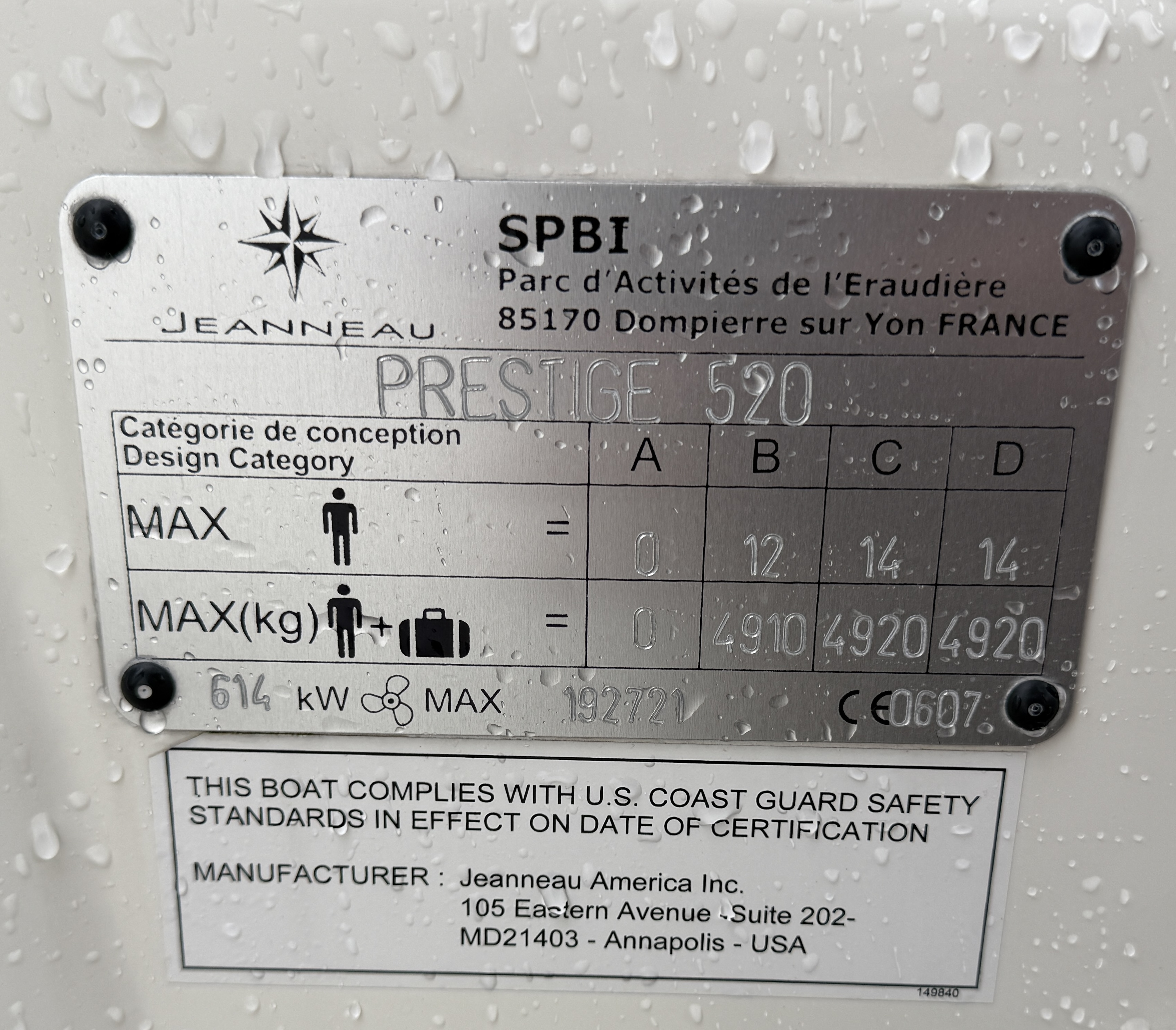
Understanding the Prestige 520 Builder’s Plate
The accompanying photograph shows the builder’s plate aboard a Prestige 520.
Design categoryMaximum personsMaximum recommended loadA00 kgB124,910 kgC144,920 kgD144,920 kg
The plate also lists maximum propulsion power of 614 kW, approximately 823 horsepower.
The zero under Category A does not mean the vessel may carry no passengers. It means that this particular boat is not certified as a Category A craft.
The plate indicates that the boat is certified for:
- Up to 12 persons under Category B parameters
- Up to 14 persons under Category C parameters
- Up to 14 persons under Category D parameters
This demonstrates an important point: the same boat may have different passenger limits depending on the conditions in which it is operated.
Suggested photo caption
Builder’s plate aboard a Prestige 520 showing different passenger and load limits for Design Categories B, C and D. The vessel is certified for 12 persons under Category B parameters and 14 persons under Categories C and D. Photo: BoatnCrew.
What Do Design Categories A, B, C and D Mean?
Categories A through D are European recreational-craft design categories. They describe the ranges of wind force and significant wave height for which a boat was designed and evaluated.
They are not passenger classes, captain-license levels or guarantees that a vessel will remain safe in every situation.
The official definitions appear in the European Union’s Recreational Craft Directive 2013/53/EU. (EUR-Lex)
Official European Union directive:
https://eur-lex.europa.eu/eli/dir/2013/53/oj/eng
PDF version:
https://eur-lex.europa.eu/legal-content/EN/TXT/PDF/?uri=CELEX%3A32013L0053
Category A
A Category A recreational craft is designed for conditions where wind may exceed Beaufort Force 8 and significant wave height may exceed 4 meters.
The category excludes abnormal conditions such as violent storms, hurricanes, tornadoes and extraordinary waves.
Category A is the most demanding of the four design categories, but it does not mean that a boat is indestructible or suitable for every possible sea condition.
Category B
A Category B recreational craft is designed for:
- Winds up to and including Beaufort Force 8
- Significant wave heights up to and including 4 meters
Many substantial cruising boats fall within Category B.
However, the upper limits associated with the category should not be treated as recommended or comfortable operating conditions. They describe design criteria, not a target for the captain.
Category C
A Category C recreational craft is designed for:
- Winds up to and including Beaufort Force 6
- Significant wave heights up to and including 2 meters
Many recreational powerboats and family cruisers fall within Category C.
Category D
A Category D recreational craft is designed for:
- Winds up to and including Beaufort Force 4
- Significant wave heights up to and including 0.3 meters
- Occasional waves reaching 0.5 meters
Category D boats are intended for relatively protected conditions.
Older descriptions commonly referred to Categories A, B, C and D as “Ocean,” “Offshore,” “Inshore” and “Sheltered Waters.” The current directive defines the categories primarily by wind force and significant wave height rather than location alone. (EUR-Lex)
What Is Significant Wave Height?
Significant wave height is not necessarily the height of the largest wave a vessel may encounter.
It is a statistical measurement based on the average height of the highest one-third of waves. Individual waves may be considerably higher.
Wave safety also depends on:
- Wave steepness
- Wave direction
- Distance between waves
- Breaking characteristics
- Wind direction
- Current
- Water depth
- The boat’s speed and heading
A Category B rating involving significant wave heights of up to 4 meters should not be interpreted as a guarantee that every 4-meter wave will be safe or manageable.
The boat’s loading, mechanical condition, speed, operator experience and distance from shelter remain critical.
Passenger Count and Weight Must Both Be Observed
When a plate lists both a maximum number of people and a maximum passenger weight, both limits must be observed.
For example, a smaller boat might display:
8 persons or 1,200 pounds
That does not necessarily permit eight people regardless of their combined weight.
The limit is reached when either:
- The maximum number of persons is reached, or
- The maximum allowable weight is reached
Children still count as persons even though they may weigh less than adults. Conversely, several larger adults may reach the weight limit before the maximum number of occupants is reached.
The Coast Guard publishes boating-safety circulars discussing capacity labels and the distinction between maximum persons and maximum weight. (USCG Boating)
U.S. Coast Guard Boating Safety Circulars:
https://uscgboating.org/content/boating-safety-circulars.php
Coast Guard capacity-label guidance:
https://uscgboating.org/library/boating-safety-circulars/bscscan64c.pdf
What Does the Weight Limit Include?
Operators must determine exactly what the weight figure on their particular plate includes.
Depending on the vessel and certification system, the stated load may include some or all of the following:
- Passengers
- Personal belongings and luggage
- Fuel
- Fresh water
- Coolers and provisions
- Safety equipment
- Fishing or diving equipment
- Portable equipment
- Tender equipment and water toys
- Other supplies carried aboard
Do not assume the entire weight allowance is available exclusively for passengers.
Fuel and water can add substantial weight before anyone steps aboard. Longer trips may also involve tools, spare parts, additional lines, food and other equipment.
The owner’s manual should be consulted whenever the meaning of a number, symbol or load figure is unclear.
For related information about fuel management and safe fueling procedures, see:
https://boatncrew.com/blog/fueling-your-boat-safely-precautions-spill-prevention-and-common-mistakes
Why Can One Boat Have Different Passenger Limits?
The photographed Prestige 520 permits 14 persons under Categories C and D but only 12 persons under Category B.
Additional passengers can mean:
- More total weight
- More passenger movement
- More weight shifting from side to side
- More weight carried on an upper deck or flybridge
- Greater demand on emergency equipment
- More people to manage during an emergency
Reducing the permitted passenger count provides an additional operating margin when stronger winds and larger seas may be encountered.
Passenger limits should therefore never be considered separately from the operating conditions.
Why Overloading Is Dangerous
An overloaded boat sits lower in the water, reducing its freeboard—the vertical distance between the waterline and the lowest point where water could enter the vessel.
Reduced freeboard makes it easier for water to come over the bow, stern or sides. Once water enters, the additional weight can further reduce stability and freeboard.
Overloading or poor weight distribution may also:
- Reduce stability
- Increase the risk of swamping or capsizing
- Cause the boat to list
- Make steering less responsive
- Increase stopping distance
- Reduce acceleration and performance
- Prevent a planing boat from getting on plane
- Obstruct visibility from the helm
- Place additional stress on the hull and machinery
- Make emergency maneuvering more difficult
New York State’s vessel-operator guidance warns that overloading can lead to capsizing and that the risk increases in rough weather or hazardous currents. (New York State Parks)
New York Public Vessel Operator’s Study Guide:
https://parks.ny.gov/sites/default/files/VesselOperatorsLicenseGuide2024.pdf
The newer 2026 New York guide also explains that capacity-plate figures are maximum limits under normal conditions and that operators should carry less weight when conditions are rough. (New York State Parks)
Weight Distribution Matters Too
A boat can be dangerously loaded even when it remains below its total passenger and weight limits.
Too many passengers in the bow can cause the vessel to ride bow-down and take water over the front. Too much weight at the stern can reduce aft freeboard and interfere with acceleration or planing.
Passengers gathering on one side can produce a dangerous list, especially on a smaller vessel.
Operators should pay particular attention to:
- Passengers moving while underway
- People gathering for photographs
- Weight carried on flybridges
- Large coolers or equipment stored on one side
- Heavy equipment placed in the bow or stern
- Passengers shifting suddenly during docking
Good weight distribution is not simply about comfort. It directly affects stability, visibility and handling.
For more practical safety guidance, visit:
https://boatncrew.com/boating-safety-guide
The Plate Is a Maximum, Not a Target
A listed passenger or weight capacity is an upper limit. It is not a goal that should automatically be reached on every trip.
The safe load may be lower when there is:
- Rough water
- Strong wind
- Limited visibility
- Cold weather
- Strong current
- A long distance from shelter
- An inexperienced passenger group
- Significant fuel, water or equipment aboard
- Excessive weight carried high on the vessel
- A mechanical, structural or stability concern
A responsible operator evaluates the vessel, passengers, load, route and expected conditions before departure.
The proper question is not simply:
Are we below the maximum?
The better question is:
Is this load safe for this boat, on this trip, in today’s conditions?
Compliance, Fines and Liability
There is no single nationwide fine that applies to every overloaded recreational boat.
Federal capacity-plate regulations primarily establish manufacturing and labeling requirements for certain boats. State and local laws may separately regulate overloading, reckless operation and unsafe passenger carriage.
Depending on the jurisdiction and circumstances, operating an overloaded or improperly loaded vessel may result in:
- A warning or citation
- Monetary fines
- Termination of the voyage
- Passengers being ordered ashore
- Reckless or negligent-operation allegations
- Increased civil liability following an accident
- Insurance coverage disputes
- Licensing consequences for a professional captain
- Criminal consequences when unsafe operation causes serious injury or death
New York regulations prohibit reckless vessel operation that endangers passengers, other people, property or the environment. (Legal Information Institute)
New York regulation example:
https://www.law.cornell.edu/regulations/new-york/21-NYCRR-751.6
The exact fine or penalty depends on the applicable federal, state or local law, the type of vessel, the operating area and what occurred.
The citation itself may be only a small part of the financial exposure. If an accident occurs, knowingly exceeding a manufacturer’s passenger or weight limit may become important evidence during:
- A Coast Guard or police investigation
- An insurance review
- A civil lawsuit
- A captain’s licensing proceeding
- A criminal prosecution involving injury or death
Operators should review the boating laws for every state or country in which they operate rather than assuming that all jurisdictions follow identical rules.
Life Jackets Must Match the People Aboard
Passenger-capacity limits and lifesaving-equipment requirements are separate issues.
Even when the vessel is within its approved capacity, it must carry the correct number and type of wearable personal flotation devices for the people aboard.
Life jackets must be:
- Approved where required
- In serviceable condition
- Properly sized
- Readily accessible
- Appropriate for the activity and operating area
BoatnCrew’s complete boating-safety section is available at:
https://boatncrew.com/safety-blog
BoatnCrew’s main blog index, which includes the article Life Jackets Explained: Types, Requirements, and Why They Matter, is available at:
Charters and Passenger-for-Hire Operations
Commercial charters and passenger-for-hire operations may be subject to requirements that go far beyond a recreational capacity plate or builder’s plate.
Depending on the operation, the requirements may include:
- A properly licensed captain
- Passenger-for-hire limitations
- Vessel inspection or documentation
- Commercial insurance
- Required lifesaving equipment
- Drug-testing compliance
- Written charter agreements
- Federal, state or local permits
A recreational capacity plate does not, by itself, authorize a vessel to carry passengers for hire.
Boat owners and operators can review BoatnCrew’s safety and professional boating articles at:
https://boatncrew.com/safety-blog
Boat owners seeking qualified captains or crew can visit:
What Every Operator Should Do Before Departure
Before leaving the dock:
- Locate and read every capacity, builder and certification plate.
- Confirm the maximum passenger count.
- Confirm the applicable passenger and total-weight limits.
- Determine what equipment and liquids are included in the listed weight.
- Account for fuel, water, provisions and personal belongings.
- Distribute passengers and equipment evenly.
- Consider the expected wind, waves, current and route.
- Reduce the load when conditions require a greater safety margin.
- Confirm that adequate life jackets and safety equipment are aboard.
- Never exceed the vessel’s applicable horsepower or loading limits.
- Consult the owner’s manual when any number or symbol is unclear.
Final Thoughts
A boat’s capacity or builder’s plate contains more than technical information. It communicates the limits within which the vessel was designed and evaluated.
The operator remains responsible for deciding whether the boat is safely loaded for the actual voyage. Weather, sea conditions, passenger behavior, weight distribution and operator experience must all be considered.
The plate tells you the maximum. Good seamanship tells you when the safe number should be lower.
Internal BoatnCrew Links
BoatnCrew Boating Safety Guide:
https://boatncrew.com/boating-safety-guide
BoatnCrew Safety Blog:
https://boatncrew.com/safety-blog
BoatnCrew Blog:
Fueling Your Boat Safely:
https://boatncrew.com/blog/fueling-your-boat-safely-precautions-spill-prevention-and-common-mistakes
BoatnCrew Homepage:
External Legal and Safety References
U.S. federal capacity-marking regulations — 33 CFR Part 183, Subpart B:
https://www.ecfr.gov/current/title-33/chapter-I/subchapter-S/part-183/subpart-B
U.S. federal safe-loading regulations — 33 CFR Part 183, Subpart C:
https://www.ecfr.gov/current/title-33/chapter-I/subchapter-S/part-183/subpart-C
U.S. federal safe-powering regulations — 33 CFR Part 183, Subpart D:
https://www.ecfr.gov/current/title-33/chapter-I/subchapter-S/part-183/subpart-D
Complete 33 CFR Part 183:
https://www.ecfr.gov/current/title-33/chapter-I/subchapter-S/part-183
U.S. Coast Guard Boatbuilder’s Handbook:
https://www.uscgboating.org/assets/PDF/downloads/FLOTATION.pdf
U.S. Coast Guard Boating Safety Circulars:
https://uscgboating.org/content/boating-safety-circulars.php
U.S. Coast Guard capacity-label guidance:
https://uscgboating.org/library/boating-safety-circulars/bscscan64c.pdf
European Recreational Craft Directive 2013/53/EU:
https://eur-lex.europa.eu/eli/dir/2013/53/oj/eng
European Recreational Craft Directive PDF:
https://eur-lex.europa.eu/legal-content/EN/TXT/PDF/?uri=CELEX%3A32013L0053
New York Public Vessel Operator’s Study Guide:
https://parks.ny.gov/sites/default/files/VesselOperatorsLicenseGuide2024.pdf
New York 2026 Public Vessel Operator’s Study Guide:
New York reckless vessel-operation regulation:
https://www.law.cornell.edu/regulations/new-york/21-NYCRR-751.6